• Pakistan hat einen überarbeiteten Friedensvorschlag vom Iran erhalten, während es als entscheidender Backchannel-Vermittler in den laufenden US-Iran-Verhandlungen fungiert, was die diplomatischen Bemühungen zur Lösung eskalierender Spannungen widerspiegelt.
• Diese Entwicklung deutet auf ein anhaltendes hochrangiges diplomatisches Engagement hin, trotz festgefahrener formaler Verhandlungen und früherer Waffenstillstandsversuche, wobei Pakistan eine strategische Vermittlerrolle in der Nahost-Krise einnimmt.
• Erfolgreiche Vermittlungsbemühungen könnten erhebliche Auswirkungen auf die globalen Märkte, die Rohölpreise und die regionale Stabilität haben und sich direkt auf Indiens Energiesicherheit und Wirtschaftswachstumsaussichten auswirken.
• Islamabad hat Berichten zufolge eine diskretere Rolle übernommen, glaubt jedoch, dass Friedensfortschritte auch ohne persönliche Treffen erzielt werden können
• Pakistan leitet Vorschläge zwischen dem Iran und den USA weiter, um die Gespräche hinter den Kulissen am Leben zu erhalten und sich schrittweise einem Friedensabkommen zu nähern, so Beamte und Experten.
• Pakistanische Beamte erklären, sie seien sich der Tatsache bewusst, dass nicht nur der regionale Frieden auf dem Spiel stehe, sondern auch der Zustand der Weltwirtschaft und die Lebensgrundlagen von Millionen der ärmsten Menschen der Welt – einschließlich in Pakistan, dessen monatliche Kosten für Energieimporte sich infolge des Krieges fast verdreifacht haben. Weiterlesen...
Pakistan officials dismiss Afghan media reports and official statements about strikes on university in Kunar province as ‘blatant lie’Mortars and missiles fired from Pakistan on Monday struck a university and civilian homes in north-eastern Afghanistan, killing seven people and wounding at least 85, Afghan officials said.Pakistan denied the accusation of targeting a university. Continue reading...
• Pakistan secured a $6 billion IMF bailout package on Monday after the International Monetary Fund approved a revised structural adjustment program focused on tax increases and subsidy reductions.
• The agreement requires Islamabad to implement value-added tax increases and privatize state-owned enterprises within the next 18 months, measures intended to stabilize the country's external account deficit.
• The U.S. welcomed the agreement, with Treasury officials noting that Pakistan's fiscal stabilization is important for regional economic security and counterterrorism financing oversight.
• Iranian Foreign Minister Abbas Araghchi returned to Islamabad on April 27, 2026, to push a new proposal through Pakistani mediators aimed at ending the US-Iran war and reopening the Strait of Hormuz.
• The proposal reached the White House, but President Trump canceled planned envoy visits by Steve Witkoff and Jared Kushner, citing lack of progress, while indirect talks continue.
• Araghchi headed to Moscow for talks with President Putin after blaming the US for failed peace efforts; Russia urged Washington to abandon ultimatums in Vienna negotiations.
• Indian and Pakistani military forces have engaged in heavy artillery exchanges along the Line of Control in Kashmir, with reports of at least 18 soldiers killed and dozens wounded in the most serious escalation in six months.
• Pakistan's military spokesperson claimed Indian forces initiated the bombardment Friday morning; India stated Pakistani positions fired first, creating conflicting narratives about the incident's origins.
• The US has urged both nations to exercise restraint and resume diplomatic channels; UN Security Council members are monitoring the situation amid concerns about potential nuclear escalation.
Steve Witkoff and Jared Kushner were to travel to Islamabad to attempt to revive ceasefire negotiationsDonald Trump said he has told US envoys not to go to Pakistan for more talks with Iran, shortly after Tehran’s top diplomat left Islamabad late on Saturday.Trump added to Fox News: “They can call us anytime they want.” The White House on Friday said Steve Witkoff and Jared Kushner would travel to Pakistan’s capital to attempt to revive ceasefire negotiations. Continue reading...
• A military confrontation along the Kashmir border escalated Friday when Pakistani forces fired on Indian positions near Uri, killing 12 Indian soldiers and wounding 18 others in the deadliest incident in two years, Pakistani military sources confirmed.
• India's military responded with retaliatory strikes, with New Delhi claiming to have neutralized three Pakistani military positions; Pakistan denied casualties on its side but acknowledged defensive operations.
• Regional analysts expressed alarm that the incident could spiral into broader conflict, warning both nations possess nuclear arsenals and recent diplomatic tensions have left few de-escalation channels open.
Iranian foreign minister has landed in Islamabad but his ministry says there will be no direct negotiations with the US envoyThe Israel Defense Forces (IDF) said it launched strikes in three areas in southern Lebanon against what it claimed were Hezbollah rocket launchers.The strikes hit the villages of Deir al-Zahrani, Kfar Reman and al-Sama’iya, which are north of where IDF forces are located in southern Lebanon. Continue reading...
• Military delegations from Pakistan and India held their first formal border security talks in 18 months in Islamabad, marking a significant thaw in bilateral tensions following last year's cross-border skirmishes.
• Both nations agreed to reinstate a communication hotline between military commanders and establish a joint investigation committee for monitoring ceasefire violations along the Line of Control.
• The US quietly supported the initiative through backdoor diplomacy, viewing improved India-Pakistan relations as essential for regional stability and counterterrorism cooperation in Afghanistan.
• US-Iran ceasefire talks collapsed in Pakistan, raising doubts over Army Chief Asim Munir's role as mediator despite Trump's prior praise.
• Concerns in US national security circles focus on Munir's alleged IRGC ties, questioning his neutrality.
• Tehran refuses further Islamabad-hosted talks, pressuring Pakistan's diplomatic standing.
Vice-president would travel with Witkoff and Kushner as ceasefire deadline looms. Plus, how to avoid an AI job scamGood morning.JD Vance is expected to fly to Islamabad to lead the US delegation on Tuesday if Iran agrees to further talks, as the deadline for the current ceasefire looms.What effect is the war having on developing countries? With food and fuel inflation reaching close to 20%, Fletcher warned: “We will feel the impact for years in sub-Saharan Africa and east Africa pushing way more people into poverty.”What are the impacts on displacement? Sexualized attacks are hastening the displacement of Palestinians, according to the report, with more than two-thirds of households surveyed identifying rising violence against women and children as a tipping point in their decision to leave. Researchers also found it was causing girls to quit school, women to stop working, and had contributed to a rise in early marriage. Continue reading...
Iranian official stresses no decision made on taking part, as US vice-president JD Vance is set to travel to Islamabad for negotiations JD Vance to lead US delegation in Pakistan if Iran agrees to talksOn Tuesday morning, Islamabad sat poised and ready to host a second round of talks – even as uncertainty reigned over whether both sides would even turn up.Pakistani officials remained optimistic that the second round of negotiations would happen, even as Iranian ministers said they would refuse to come to the table under the threat of “force” and it remained unclear exactly when US vice-president JD Vance planned to depart Washington for Islamabad. Continue reading...
US vice-president to travel to Islamabad with Steve Witkoff and Jared Kushner as deadline for current ceasefire loomsPakistan seeks to raise its global standing in push for Middle East peaceMiddle East crisis – live updatesJD Vance is expected to fly to Islamabad at the head of a US diplomatic delegation on Tuesday if Iran agrees to further talks in the Pakistani capital as the deadline for the current ceasefire looms.The US vice-president will travel with Steve Witkoff, Donald Trump’s special envoy, and Jared Kushner, the president’s son-in-law – though Iran’s president warned there remained a “deep historical mistrust” of the US. Continue reading...
Islamabad has seized chance to act as mediator in Iran war and hopes to reap diplomatic and economic benefitsMiddle East crisis – live updatesAs Pakistan works frantically to narrow differences between Iran and the US in its newfound role as global peacemaker, it is also seeking to recast its diplomatic standing and attract business.Pakistani officials, mediating between an unpredictable US president and hardliners in Tehran, were on Monday trying to coax both sides to put the conditions in place for a second round of talks in Islamabad this week, including easing the standoff in the strait of Hormuz. Pakistan was optimistic that the meeting would happen, viewing objections voiced by the Iranian side and Donald Trump’s threats as posturing for domestic audiences. Continue reading...
Unclear whether Iran will take part in talks as US president repeats threat to destroy Iranian infrastructureMiddle East crisis – live updatesDonald Trump’s representatives will return to Pakistan on Monday for another possible round of talks aimed at ending the US-Israeli war in Iran, as the US president repeated his threats to Iranian infrastructure unless Iran agrees to a deal.The return of a US delegation to Islamabad, led by vice-president JD Vance, along with Trump’s special envoy, Steve Witkoff, and his son-in-law, Jared Kushner, comes after Iran on Saturday reimposed tight restrictions on the transit of commercial shipping in the strait of Hormuz, reversing an agreement made hours before to reopen the strategic waterway, over the US’s refusal to lift its naval blockade. Continue reading...
• Artillery and small arms fire erupted along the Line of Control in Kashmir on April 17-18, marking the first significant border clash in eight months and resulting in at least 12 reported casualties on both sides.
• Pakistan accused Indian forces of violating a 2003 ceasefire agreement with unprovoked shelling near the Siachen Glacier region; India's military claimed Pakistan-based militants initiated the exchange.
• Both nations mobilized additional military units to their shared border; analysts warn the escalation could undermine fragile diplomatic channels reopened in late 2025.
US military boasts blockade of the strait of Hormuz will incapacitate Iran’s economy; Trump says negotiations could return to PakistanUS-Iran peace talks could resume in next two days, Trump saysWelcome to the Guardian’s continuing coverage of the crisis in the Middle East.The US military has said American forces have completely halted economic trade going in and out of Iran by sea through a blockade.An estimated 90% of Iran’s economy is fueled by international trade by sea. In less than 36 hours since the blockade was implemented, U.S. forces have completely halted economic trade going into and out of Iran by sea.”Donald Trump has said that talks with Iran could resume in Pakistan over the next two days, according to an interview with the New York Post. “Something could be happening over the next two days, and we’re more inclined to go there,” Trump was quoted as saying.US secretary of state Marco Rubio said Israel-Lebanon talks in Washington on Tuesday were a “historic opportunity”. He said that while every complexity would not be resolved immediately, he hoped the parties would begin to move forward.Lebanon’s president expressed hope that direct talks would lead to an end to his country’s “suffering” after war erupted again between Israel and Hezbollah last month. “I hope that the meeting in Washington... will mark the beginning of the end of the suffering of the Lebanese people in general, and those in the south in particular,” president Joseph Aoun said in a statement, adding that “stability will not return to the south if Israel continues to occupy its lands”.Lebanon’s top envoy to the US said the high-level diplomatic engagement between her country and Israel was “constructive,” but urged an end to the ongoing conflict between Israel and Iran-backed Hezbollah militants that has displaced thousands of Lebanese. After participating in Tuesday’s talks with Rubio and Israel’s ambassador to the US, Nada Hamadeh Moawad said she had “underscored the need to preserve our territorial integrity and state sovereignty”.The US will not renew a 30-day waiver of sanctions on Iranian oil at sea that expires this week officials told Reuters, as the US imposes a blockade on shipments from Iranian ports.UK prime minister Keir Starmer and French president Emmanuel Macron will co-host a summit in Paris on Friday focused on efforts to reopen the strait of Hormuz, Downing Street said. A spokesperson said: “The summit will advance work towards a coordinated, independent, multinational plan to safeguard international shipping once the conflict ends.”Trump criticised Italian prime minister Giorgia Meloni, a political ally, in an interview published on Tuesday for her unwillingness to help in the Iran war. “I’m shocked at her. I thought she had courage, but I was wrong,” he told Italian daily Corriere della Sera.Foreign ministers from Saudi Arabia, Pakistan and Egypt will meet Turkey’s top diplomat this week for talks on regional matters, a ministry source told AFP on Tuesday. “This is the third meeting of the four countries to discuss regional affairs, not specifically Hormuz,” said the source, who wished to remain anonymous.Hezbollah said it targeted 13 northern Israeli towns with rockets shortly after the start of Lebanese-Israeli talks in Washington. In a statement, the group said it targeted Kiryat Shmona, Metula and 11 other towns “with simultaneous rocket salvos” at 6.15pm.US treasury secretary Scott Bessent has said the underlying US economy remains strong and that growth could still exceed 3% or 3.5% this year despite the impact of the US-Israel war on Iran. Earlier on Tuesday, the International Monetary Fund (IMF) cut its growth forecasts for 2026 based on the impact of the war and said any further escalation in the conflict could trigger a global recession. Bessent however cast cuts in global growth forecasts and higher inflation projections by the IMF and World Bank as an overreaction. Continue reading...
JD Vance leads American delegation while Iran’s negotiators headed up by Iran’s parliamentary speakerPeace talks between Iran and the US began in Islamabad this afternoon, with senior negotiators from both countries meeting face to face at the highest level for the first time since 1979, in the presence of mediators from Pakistan.Pakistani state TV said US and Iranian officials were “sitting directly at the same table” – which was later confirmed by the White House – and discussions were beginning in a positive atmosphere, despite fighting ongoing in Lebanon. Continue reading...
• An Iranian diplomatic delegation has arrived in Pakistan to begin ceasefire talks with US representatives, signaling potential de-escalation efforts amid the ongoing conflict that began February 28, 2026.
• The negotiations come as both sides seek to resolve tensions triggered by the death of Iranian Supreme Leader Ali Khamenei and Iran's closure of the Strait of Hormuz, which has caused the largest global oil supply disruption since the 1970s energy crisis.
• US Vice President JD Vance has warned Iran not to "play" the US during planned negotiations, indicating the administration's determination to achieve concrete results from the talks.
• Fresh tensions have surfaced just as formal ceasefire negotiations between US and Iranian representatives commence in Pakistan, threatening to derail diplomatic efforts.
• The timing of new military incidents and heightened rhetoric suggests both sides remain committed to military posturing even as they engage in peace talks, a pattern common in complex regional conflicts.
• Diplomatic observers note that success will require both delegations to compartmentalize military operations from negotiation processes, a significant challenge given recent escalations including the downing of a US fighter jet.
• Pakistan has positioned itself as a primary mediator between the United States and Iran following the recent Middle East war, leading efforts to end hostilities after Trump's threats prompted a White House reversal.
• Peace talks are set to begin in Pakistan on April 10, welcomed by India, as the two-week ceasefire takes hold amid reshaping West Asian strategic landscape.
• China supports Pakistan's role, having jointly submitted a five-point truce plan with Islamabad to reopen the Strait of Hormuz before escalation.
• Pakistani and Indian troops exchanged heavy artillery fire across the Line of Control in Kashmir on April 8, 2026, killing 7 Pakistani and 5 Indian soldiers.
• Pakistan accused India of initiating the clash near Uri sector; India claimed retaliation to 'unprovoked shelling' that hit civilian areas.
• The incident risks broader conflict between nuclear powers, prompting US Secretary of State Antony Blinken to call for 'immediate ceasefire' in talks with both nations.
Pakistani officials defy the skeptics to lead a breakthrough in negotiations and help avert catastrophe in Iran Middle East crisis – live updatesPakistan’s leaders had almost lost hope. After more than two weeks of frantic negotiations, phonecalls and diplomatic summits to try to end the US-Israeli war with Iran, it looked like the conflict might instead be escalating into Islamabad’s worst nightmare.In a cabinet meeting held around 5pm on Tuesday, Pakistan’s prime minister Shehbaz Sharif was morose. “We should brace ourselves for the impact of the war,” he told his cabinet ministers. “The situation has really become very bleak. The chance of peace has become dim.” Continue reading...
• Pakistani military conducted airstrikes on alleged militant camps in Kashmir-administered territory on April 6, claiming to target terrorist training facilities; India responded with counter-strikes, marking the most significant escalation in months.
• Both nations reported military casualties and damaged infrastructure; Pakistan claimed two Indian jets were damaged, while India denied losses and accused Pakistan of unprovoked aggression.
• International observers including the US and UN called for de-escalation and urged both countries to exercise restraint; diplomatic channels remain active but tensions are at their highest since late 2025.
• Pakistan, Turkey, Saudi Arabia, and Egypt have initiated mediation between the US and Iran to end the ongoing war, relaying messages since its start.
• An Islamabad-brokered ceasefire plan was presented to both sides on Monday, proposing a 15-20 day settlement with immediate ceasefire and reopening of the Strait of Hormuz ahead of a US Tuesday deadline threatening escalated strikes.
• Earlier on March 25, a 15-point US proposal via Pakistan demanded dismantling Iran's nuclear facilities, missile limits, and a 30-day ceasefire, countered by Iran's five conditions including compensation and maritime control rights.
• Following April 1 shelling that killed 12 Indian soldiers and 8 Pakistani troops, US-mediated talks led to a 72-hour ceasefire along the Line of Control.
• Details include troop pullbacks by 2 km and no-fly zone for drones, verified by US satellites.
• The de-escalation prevents nuclear escalation fears, with markets in Mumbai and Karachi rising 1.8%.
Foreign ministers Ishaq Dar and Wang Yi met in Beijing as Pakistan pushes for peacemaker roleMiddle East crisis – live updatesPakistan and China have released a joint five-part proposal for peace in the Middle East, after Pakistan’s foreign minister flew to Beijing on Tuesday to seek Chinese support for the country’s faltering efforts to negotiate an end to end the war.The one-day meeting between Ishaq Dar and his Chinese counterpart, Wang Yi, came as Pakistan continues to push for the role of peacemaker between the United States and Iran, even as the war shows little sign of relenting. Continue reading...
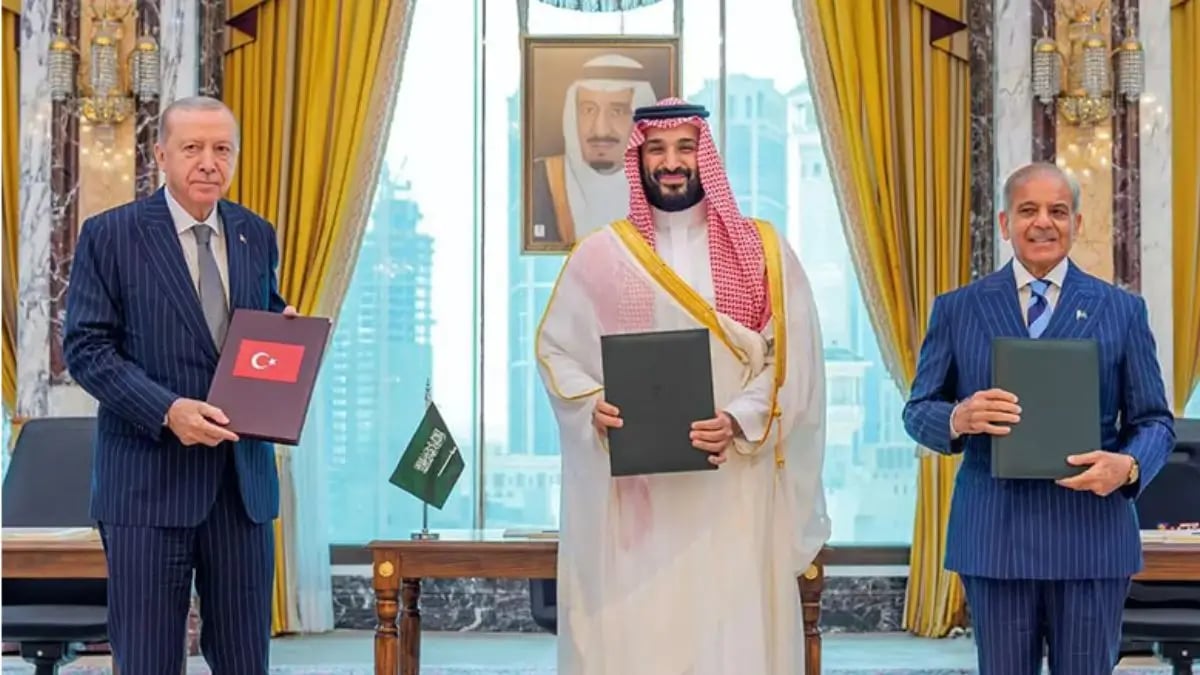
The meeting of foreign ministers was, in a way, the opening ceremony of an initiative that is intriguing diplomatsMiddle East crisis – live updatesThe meeting on Sunday of the foreign ministers of Egypt, Pakistan, Saudi Arabia and Turkey in Islamabad not only represented the best hope for a ceasefire in Iran but was also the embryo for a new order designed to curb Israeli and Iranian dominance after the war.Although the four nations have met as a quartet before, the one-day meeting of foreign ministers in Islamabad on Sunday was, in a way, the official opening ceremony of an initiative that is intriguing diplomats. Continue reading...
• Regional diplomats from Saudi Arabia, Turkey, and Egypt met in Pakistan on Sunday to establish a framework for direct US-Iran negotiations, with foreign ministers expected to reconvene Monday to discuss peace terms.
• Iran's parliament speaker Mohammed Bagher Qalibaf warned that Iranian forces are "waiting for the arrival of American troops on the ground to set them on fire," while dismissing the US 15-point action list as negotiating under pressure.
• The US has deployed thousands of troops to the Middle East including 2,500 Marines aboard USS Tripoli and elements of the 82nd Airborne Division, signaling preparations for potential ground operations despite diplomatic efforts.