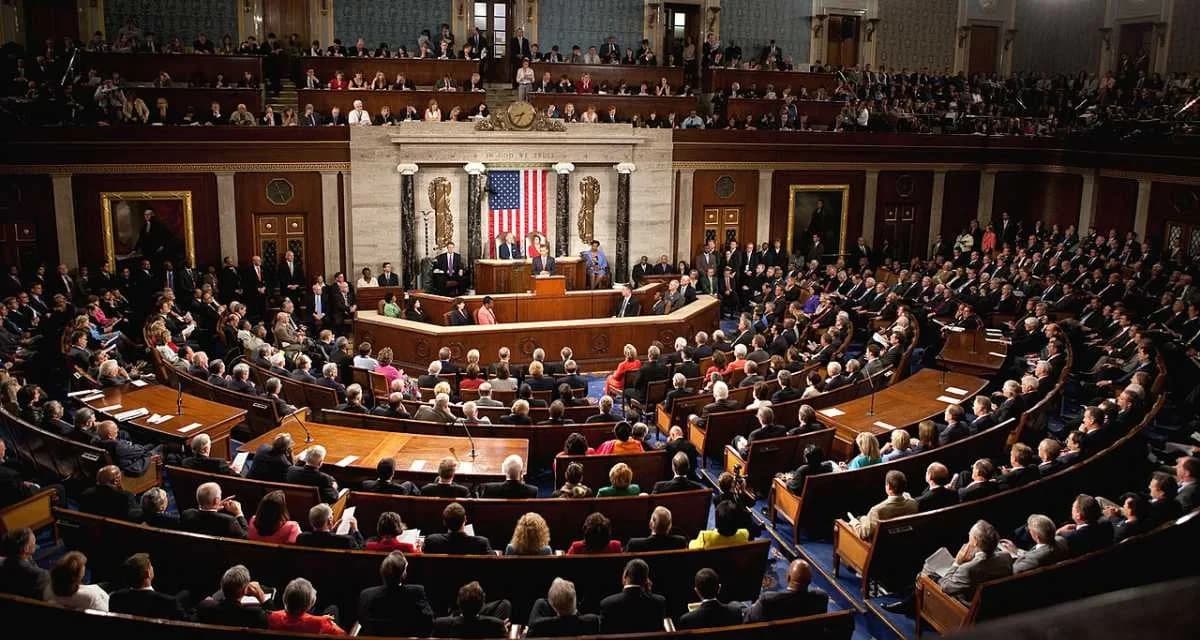
International Democracy Watchdog Reports Trump Administration Dismantling US Democracy at Unprecedented Rate

- The Varieties of Democracy Institute at Sweden's Gothenburg University found that Trump's second term is characterized by swift concentration of executive power, suppression of dissent, and targeting of civil rights at a rate comparable to some coups d'état.
- The Trump administration is flouting Congress and the judiciary, attacking courts while the Department of Homeland Security openly violates dozens of judicial orders, and has unilaterally reallocated federal funding including a $10 billion gift to the "Board of Peace" without congressional approval.
- Republican-controlled Congress has "abdicated its constitutional role" by ceding legislative, fiscal, and oversight powers to the executive branch during 2025, while the administration undoes civil rights achievements and suppresses left-wing dissent.
- Researchers warn 2026 is critical for US democracy due to midterm elections, but note that 70 percent of autocratizations under the modern wave have been reversed, suggesting decline is not inevitable.
Sources & Citations
1 sourceMore Stories
U.S. House of Representatives passes bill to fund the government through December 4 - NEWS.am
• The U.S. House of Representatives passed a bill to maintain current funding levels for federal agencies through December 4. • This legislative move is designed to avert a government shutdown and ensure operational continuity until the end of the fiscal year.
Read original · news.am NEWS.am
Justices say Supreme Court ethics reform is complicated. It isn’t. - The Boston Globe
• The Boston Globe argues that the U.S. Supreme Court lacks a truly enforceable ethics code, relying instead on an "honor system" governed by the justices themselves. • This system contrasts sharply with other federal judges, who face strict sanctions ranging from formal reprimands and suspensions to potential impeachment referrals.
Read original · bostonglobe.com The Boston Globe
House Republicans to write $95bn bill to fund Iran war and aid farmers | House of Representatives
• House Republicans are drafting a $95 billion reconciliation bill designed to fund the war in Iran and provide financial aid to farmers. • The GOP-controlled chamber is attempting to allocate $10 billion toward the "Save America Act," a measure championed by Donald Trump to ban mail-in ballots and tighten voter ID requirements.
Read original · theguardian.comHouse GOP advances $95 billion plan to fund Iran war and SAVE America Act - CBS News
• House Republicans passed a budget resolution that includes a $95 billion plan to fund efforts related to the Iran war and the "SAVE America Act." • The resolution initiates the party-line reconciliation process, which allows for certain legislative changes to pass with a simple majority.
Read original · cbsnews.comLast 15 Hours: Every Major Sonam Wangchuk Protest Update in 30 Seconds - India Today
• Activist Sonam Wangchuk's ongoing protests have escalated over the last 15 hours, involving new controversial videos, fresh scuffles, and demonstrations at Parliament. • The situation has drawn significant attention through Opposition visits and a Public Interest Litigation (PIL) filed in the Delhi High Court.
Read original · indiatoday.in India Today
Parliament washout again; govt reaches out to opposition to end impasse
• Both Houses of Parliament experienced a washout of proceedings for the third consecutive day as the government and opposition remained deadlocked. • The impasse was fueled by a hardening stance from the anti-BJP bloc following a police crackdown on student protests.
Read original · timesofindia.indiatimes.comHere's what to know about India's 'Cockroach' movement challenging Modi
• A protest movement dubbed the "Cockroach" movement has emerged in India, evolving from a joke into a significant challenge against Prime Minister Narendra Modi's Hindu nationalist government. • The movement is driven by India's youth, a critical voting bloc consisting of hundreds of millions of citizens under 35, including millions of first-time voters.
Read original · apnews.comASEAN: Five key takeaways from the foreign ministers’ meeting in Manila
• ASEAN foreign ministers convened in Manila on July 21 to begin a four-day series of diplomatic talks scheduled to conclude on July 24. • The 59th ASEAN Foreign Ministers’ Meeting focuses on critical regional security issues, including tensions in the South China Sea and the ongoing conflict in Myanmar.
Read original · anewz.tv AnewZ
AnewZCould India’s Cockroach party bring down Modi? – Full Story podcast | India
• Nour Haydar and Hannah Ellis-Petersen discuss the drivers behind a surge of growing protests across India. • The conversation examines the emergence of unconventional political movements, such as the "Cockroach party," and their potential to challenge Prime Minister Narendra Modi's administration.
Read original · theguardian.comA protest movement is challenging India's establishment. What to know about the 'Cockroaches' - Japan Today
• A youth-led protest movement in India, calling themselves the "Cockroaches," has evolved from an online joke into a significant political challenge against the country's establishment. • The movement is driven by young Indians who are channeling their anger over government failings and the perceived damage caused by the current political structure.
Read original · japantoday.com Japan Today
Narendra Modi faces the biggest youth protest movement of his rule, the Cockroach Janta Party - 23-Jul-2026 - NZ International news
• A youth-led uprising known as the Cockroach Janta Party has emerged as the most significant protest movement during Prime Minister Narendra Modi's 12-year tenure. • The movement was initiated by a student leader who is rapidly gaining influence and challenging the established political order in India.
Read original · home.nzcity.co.nzHere are the latest news and big news stories to follow - The Hindu
• Opposition MPs met with Lok Sabha Speaker Om Birla on Wednesday to request the withdrawal of the suspension of Trinamool Congress member Kalyan Banerjee. • The MPs argue that the alleged altercation leading to the suspension took place after the House had already been adjourned, making the current rules inapplicable.
Read original · thehindu.com