S&P 500 Holds Near Record Highs Despite Iran Conflict as Earnings Surge 17%

- US stocks demonstrated resilience amid Iran geopolitical tensions and high energy prices, with the S&P 500 up nearly 2% year-to-date by April 14, just 1% below its January 27 all-time high.
- The index's maximum drawdown stayed under 10%, cushioned by forward earnings estimates growing at a 17% annual rate despite a 20% drop in P/E ratios.
- S&P 500 profit margins hit new highs around 15% in early April, driven by broad fundamentals including AI and the One Big Beautiful Bill Act effects, not just energy sector gains.
- Fidelity's Jurrien Timmer noted, “Earnings estimates have been flying... That resilience in earnings and in the economy has allowed the stock market’s price decline to be very modest.”
Sources & Citations
1 sourceMore Stories
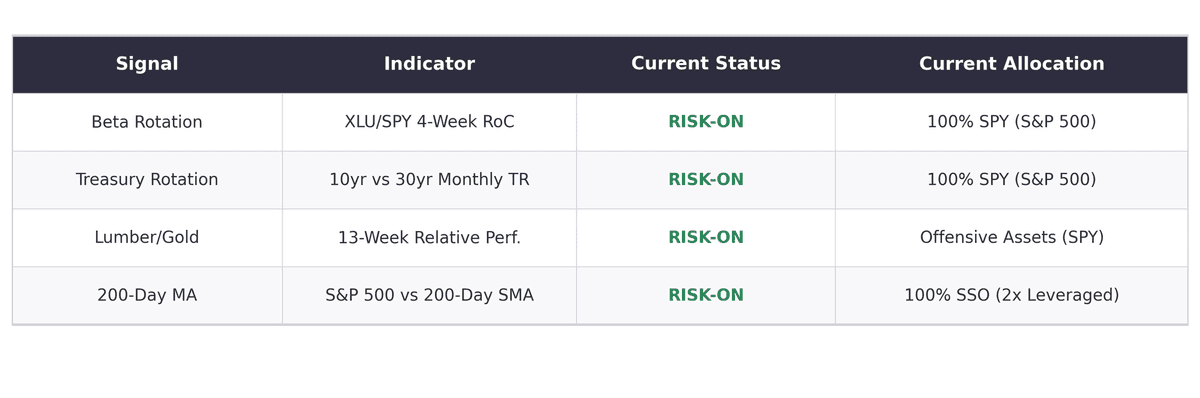
The Full Risk-On Stack
• Intermarket signals across trends, rotation, commodities, and Treasuries are currently unanimously aligned in a "risk-on" posture. • The framework utilizes the 200-day Moving Average as a binary trigger to determine leverage, allocating to SSO (2x leveraged S&P 500) when prices are above the average and SPY when below.
Read original · leadlagreport.com The Lead-Lag Report
European stocks steady as investors weigh Hormuz risks, data calendar
• European stocks remained steady on Monday, with the pan-European STOXX 600 holding at 660.12 points following a record-high close on Friday. • Market stability comes as investors balance elevated oil prices driven by uncertainty over the reopening of the Strait of Hormuz against a packed upcoming economic data calendar.
Read original · finance.yahoo.comStocks in news: Wipro, BSE, Vodafone Idea, Hyundai India and Airtel - The Economic Times
• Indian stock markets experienced fluctuations as investors balanced interest rate prospects against geopolitical tensions and rising oil prices. • In a significant index shift, BSE Ltd will enter the Nifty index, replacing Wipro.
Read original · economictimes.indiatimes.comFive things to watch in markets in the week ahead By Investing.com
• Gold prices have retreated from a seven-week high as investors balance Iran-related war uncertainty with anticipation of upcoming CPI data. • Oil prices are trending upward due to elevated supply risks and ongoing instability surrounding the Strait of Hormuz.
Read original · in.investing.comThis stock market indicator just flashed a warning not seen since the dot-com bubble
• A key stock market valuation indicator has flashed a warning signal not seen since the dot-com bubble of the late 1990s. • The metric tracks the price of a stock index relative to its average inflation-adjusted earnings over the preceding 10 years.
Read original · finance.yahoo.com Yahoo! Finance
Stock market concentration: When a few stocks become the market
• Global stock indices are experiencing increasing concentration, where a small handful of companies and sectors now drive the overall performance of entire markets. • South Korea is cited as a primary example of the risks associated with this trend, serving as a warning to investors when concentration becomes excessive.
Read original · atlanticcouncil.org Atlantic Council
Thoughts for the day NEWS - by Len Watson - GIABHS.com
• Asian equities broadly advanced on Monday, driven by momentum from Friday's U.S. post-payroll rally. • Japan's Nikkei surged over 2%, and Hong Kong markets gained, though mainland Chinese blue chips weakened due to soft inflation and domestic demand concerns.
Read original · thoughtsfortheday.substack.comAsian Markets Track Wall Street Higher
• Asian stock markets traded mostly higher on Monday, following a positive trend established by Wall Street on Friday. • The market rally is driven by easing concerns that the U.S. Federal Reserve will implement an imminent interest-rate hike.
Read original · rttnews.comIC Markets – Asia Fundamental Forecast | 10 August 2026 | IC Markets
• The U.S. trading session was primarily driven by labor-market data and shifting Federal Reserve expectations, causing volatility in the U.S. dollar and Treasury yields. • Policymakers are closely monitoring sharp fluctuations in the Japanese yen due to their potential influence on global financial conditions and inflation.
Read original · icmarkets.com.au IC Markets
Banking Stocks to Buy: Axis Bank, ICICI Bank, SBI and others - Top 9 analyst picks with up to 27% upside potential | Full list - Markets
• Market analysts have identified nine top banking stocks to buy, citing strong fundamentals and positive earnings momentum across the sector. • Axis Bank is the top pick among the list, with analysts projecting a significant upside potential of 27.46%.
Read original · etnownews.comStock recommendations for 10 August from MarketSmith India
• MarketSmith India has released its top stock recommendations for investors on 10 August to guide daily trading and investment decisions. • The recommendations come amid significant risk factors, including price volatility in aluminium and copper, high energy costs, and potential oversupply driven by China.
Read original · livemint.comNifty, Sensex likely to open flat amid CAS rollout - The HinduBusinessLine
• The Nifty and Sensex are expected to open flat on Monday as investors monitor US inflation data, Middle East tensions, and Foreign Portfolio Investor (FPI) flows. • Market participants are specifically tracking the rollout of the new closing auction session (CAS) and its potential impact on trading.
Read original · thehindubusinessline.com The Hindu BusinessLine