राज्य समाचार एजेंसी Xinhua ने बताया कि सत्तारूढ़ কমিউনিস্ট पार्टी की शीर्ष निर्णय लेने वाली संस्था, पॉलिटब्यूरो ने कहा है कि इस साल अर्थव्यवस्था की शुरुआत उम्मीद से बेहतर रही है।
• CrowdStrike disclosed on April 25, 2026, a sophisticated cyberattack via compromised third-party software affecting 2.5 million patient records at UnitedHealth's Change Healthcare subsidiary.
• Attackers, linked to North Korean Lazarus Group, exfiltrated data over 72 hours before detection, demanding $22 million ransom.
• Incident highlights vulnerabilities in US healthcare IT supply chains, prompting HHS emergency directives for 500+ providers.
• CrowdStrike disclosed on April 20, 2026, a sophisticated supply chain attack affecting 1,200 US clients, including Fortune 500 firms, via compromised third-party software.
• Attackers deployed ransomware, encrypting critical systems and demanding $50 million in Bitcoin; no data exfiltration confirmed yet.
• The incident highlights rising risks in software supply chains, echoing SolarWinds breach, with FBI joining investigation.
• The US administration reports that the Iran war is rattling the medical supply chain, affecting essentials from gloves to helium used in MRIs.
• Shortages threaten hospitals nationwide as key imports from affected regions halt abruptly amid escalating conflict.
• Medical leaders warn this could delay treatments and surgeries, exacerbating existing vulnerabilities in US healthcare logistics.
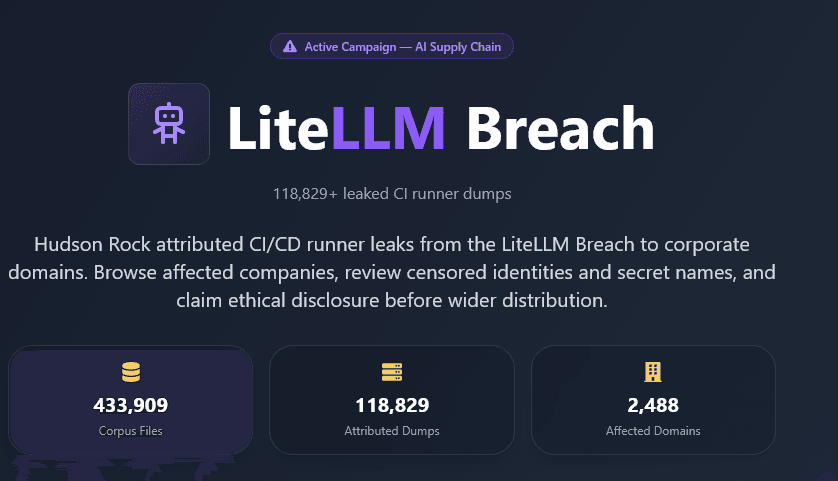
• AI recruiting platform Mercor confirmed a cybersecurity incident from a supply chain attack on open-source project LiteLLM, with hacker group Lapsus$ claiming data access and theft.
• The breach exposed Mercor's systems, highlighting vulnerabilities in AI supply chains used by startups for model integration.
• This incident underscores rising risks for AI firms relying on third-party libraries, potentially impacting hiring trust and data security standards.
• The U.S. government has designated Anthropic's Claude AI model as a potential supply-chain risk amid evaluations for military applications.
• This follows Department of Defense introductions of new guardrail policies for military AI use, with xAI’s Grok also entering classified systems.
• The move highlights growing scrutiny on AI models' security and reliability for national defense.
• U.S. District Judge Rita Lin ruled in favor of AI firm Anthropic, temporarily blocking the Pentagon from branding it a supply chain risk after failed defense contract talks.
• The ruling also halts President Trump's directive for federal agencies to stop using Anthropic's Claude AI, following a hearing on March 24 in San Francisco federal court.
• Judge Lin criticized the measures as punitive rather than protective, noting the government could simply cease using Claude without broader actions.
• Anthropic filed a lawsuit in San Francisco federal court on March 24, 2026, urging a judge to block the Pentagon's designation of the AI firm as a supply-chain risk.
• The company described the label as 'unprecedented and stigmatizing,' amid a feud with the Trump administration over potential AI use in warfare.
• A hearing occurred on Tuesday before Judge Lin, with Anthropic also filing a separate case in Washington, D.C. federal appeals court.
• The U.S. National Science Foundation on March 24, 2026, named winners of the multi-year Critical Minerals Challenge, including alkaLi Labs, ChemFinity Technologies, Intel-E-Waste, and University of Wisconsin-Madison, to secure domestic supply chains for lithium, cobalt, rare earths, and other metals.
• Winners develop innovations like engineered biosorbents recovering lithium from byproducts, tunable polymer sorbents capturing over 25 metals at room temperature, modular e-waste processing platforms, and electrochemical electrodes generating acids in situ.
• The program, co-designed with Germany’s SPRIND Tech Metal Challenge, uses donated e-waste from IBM and Aurubis with U.S. Naval Research Laboratory collaboration for national security relevance and real-world validation.
Shipments to Russian smelters from Aughinish Alumina have increased sharply since the invasion of UkraineA leading Irish metals refinery is part of an international aluminium supply chain that appears to conclude with shipments to arms producers feeding the Kremlin’s war machine in Ukraine, leaked records and public data suggests.Trading records show that shipments to Russian smelters from Aughinish Alumina, which is located on the Shannon estuary in the west of Ireland and has been owned by the Russian aluminium group Rusal since 2006, have increased sharply since the invasion of Ukraine in 2022. Continue reading...