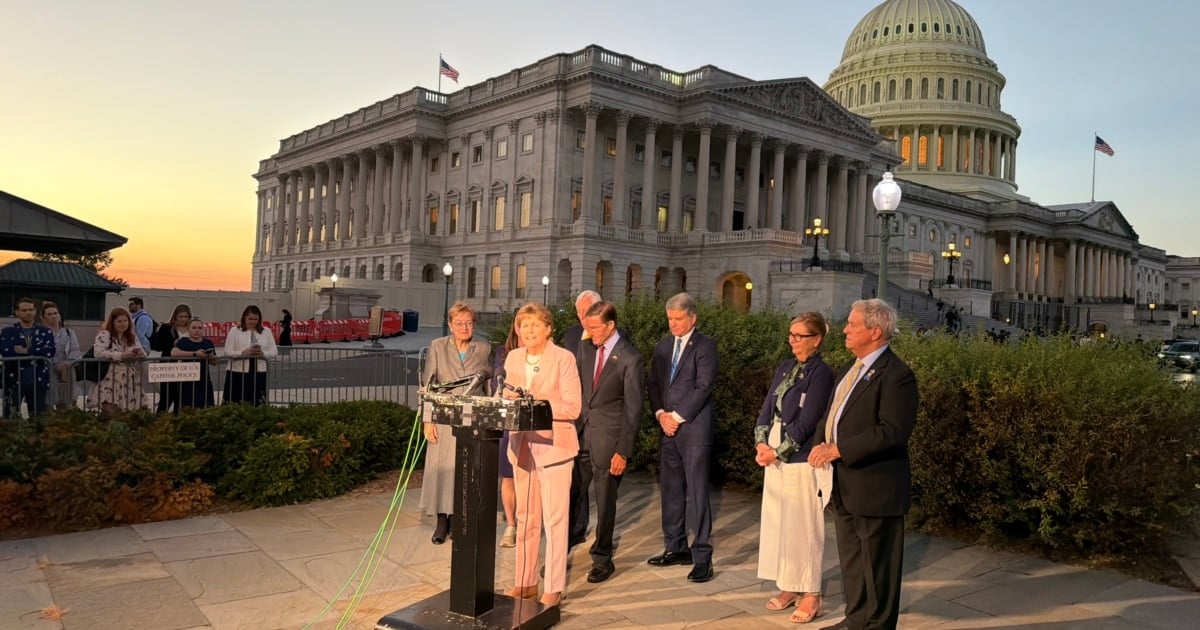
β’ House Speaker Mike Johnson and Senate Majority Leader John Thune unveiled a plan to fully fund the Department of Homeland Security, resolving a 48-day partial government shutdown.
β’ The agreement bypasses prior splits between GOP leaders, aiming to restore pay for affected federal workers.
β’ Trump endorsed the measure, signaling he will sign a related executive order soon.
β’ Congress reauthorized the Dr. Lorna Breen Health Care Provider Protection Act, extending mental health support programs for healthcare professionals through September 2030.
β’ Named after emergency physician Dr. Lorna Breen, who died by suicide during the COVID-19 pandemic, the law addresses burnout among nurses and others.
β’ The legislation continues federal initiatives to improve workplace conditions and reduce mental health challenges in healthcare.
β’ President Trump is pressing Congress to cut short its two-week recess and return to fund the Department of Homeland Security, now over 40 days into the longest partial government shutdown in U.S. history.
β’ White House press secretary Karoline Leavitt stated Trump offered to host a big Easter dinner if lawmakers return to fight Democrats on the issue.
β’ The House passed a bill to fund DHS through May 22, but top Democrats called it 'dead on arrival' in the Senate; Senate partially funded DHS except ICE and border protection last Friday.
β’ House Speaker Mike Johnson rejected a Senate-negotiated Department of Homeland Security funding deal early Friday, dramatically denouncing the agreement reached after weeks of effort by Senate Majority Leader John Thune.
β’ The collapse leaves DHS in a partial shutdown since mid-February with Congress now on a two-week spring break, creating an impasse with no clear path to resolution.
β’ The rupture between the two top Republican leaders exposes rare discord as they work to advance President Trump's priorities before November elections.
β’ President Trump called on a gridlocked Congress to establish a unified national AI regulatory framework to prevent a patchwork of state laws on March 28, 2026.
β’ States have enacted dozens of AI laws covering child safety, transparency requirements, and whistleblower protections due to federal inaction.
β’ The White House framework emphasizes protecting children from AI harms and consumers from data center cost increases, prompting mixed reactions from lawmakers.
β’ Reps. Nikki Budzinski (D-Ill.) and Adrian Smith (R-Neb.) introduced the Preventing Real-time Exploitation and Deceptive Insider Congressional Trading Act on March 25, 2026, prohibiting members of Congress, the president, vice president, spouses, dependents, and senior executive branch employees from trading in prediction markets on political events or policy decisions.
β’ The bill imposes civil penalties of 10% of the violating transaction's value plus full disgorgement of profits to the U.S. Treasury, amid rising bipartisan concerns over platforms like Polymarket and Kalshi.
β’ 'The American people are tired of politicians using their influence for personal gain, and the rise of prediction markets has made those concerns even more relevant,' Budzinski stated.
β’ On March 20, 2026, the White House issued the National Policy Framework for AI, urging Congress to preempt state laws and promote innovation.
β’ Framework emphasizes five principles: child safety, communities, creators, censorship prevention, and U.S. competitiveness, building on December 2025 executive order.
β’ Recommendations include protections against AI scams, workforce training via land-grant institutions, and free speech safeguards for AI outputs.
β’ Republicans in Congress are escalating investigations into multiple aspects of the Trump administration, including communications between the administration and private companies, financial contributions to Trump's White House ballroom, and settlement funds for the Trump Presidential Library.
β’ Congressional Republicans are scrutinizing federal contracts awarded to companies with ties to the administration, potentially improper use of government information by the Department of Government Efficiency (DOGE), and business investments related to Trump family interests in defense, drone, crypto, real estate, and media industries.
β’ Investigations are also focusing on presidential pardons, with Democrats seeking transcribed interviews of individuals pardoned by Trump and related parties where allegations exist of donations or inappropriate influence linked to the pardons.
β’ House Republicans announced an investigation into rampant hospice fraud in Southern California, alleging tens of millions in taxpayer funds lost to improper payments.
β’ The House Oversight Committee sent a letter to Governor Gavin Newsom requesting documents on state oversight of federally funded hospice programs.
β’ Fraud involves companies receiving payments for ineligible patients, prompting calls for stronger controls amid ongoing healthcare waste concerns.
Airline CEOs have urged Congress to restore funding to the TSA as lengthy security lines plague US airportsSign up for the Breaking News US email to get newsletter alerts in your inboxDelta Air Lines is partly suspending its speciality service desk for members of Congress until funding for the Transportation Security Administration (TSA) is restored, the airline confirmed on Tuesday, as security lines stretch for hours at airports across the country due to the Department of Homeland Security (DHS) shutdown.The service desk is used to help members of Congress book flights at special government rates, secure airport escorts and make last-minute changes to flights. Continue reading...
β’ The Trump administration on Friday unveiled a sweeping legislative blueprint for regulating artificial intelligence, pressing Congress to establish a clear federal framework as the administration has threatened broadband and internet funding restrictions on states with overly restrictive AI regulations.
β’ OpenAI signaled support for state-level alignment around California and New York models in the absence of national framework, while Google's Kent Walker flagged pro-big tech governor-backed legislation as exemplary.
β’ Despite the White House push for swift action, the legislation faces a challenging path in Congress, with two previous attempts by the administration to enshrine federal preemption having failed.
β’ The American Podiatric Medical Association announced strong support for the Diabetes Foot Health Access and Modernization Act, bipartisan legislation introduced in the House on March 13 and Senate on March 17, 2026.
β’ The bill aims to improve health outcomes for approximately 1 in 3 Medicare patients and 1 in 7 Medicaid patients living with diabetes by modernizing outdated policies affecting foot and ankle care.
β’ Lead sponsors include Reps. John Joyce (R-PA), Diana DeGette (D-CO), Mike Rulli (R-OH), Kim Schrier (D-WA), Mike Kennedy (R-UT), and Darren Soto (D-FL) in the House, and Senators Todd Young (R-IN) and Raphael Warnock (D-GA) in the Senate.
β’ The U.S. Senate unanimously passed Sen. John Cornyn's (R-TX) End Special Treatment for Congress at Airports Act on March 20, 2026, requiring members of Congress to undergo standard TSA screening like other passengers.
β’ The bill prohibits federal funds for expedited access at checkpoints, addressing perks that allow lawmakers to bypass lines amid a DHS funding shutdown affecting 120,000 employees without paychecks.
β’ Cornyn stated, 'Members of Congress are getting an unfair perk... trust in Congress is at an all-time low,' emphasizing restoration of public trust as key impact.
β’ A Congressional Budget Office report released March 19, 2026, estimates laws from the 119th Congress's first session (Jan 2025-Jan 2026) will boost the 2025-2034 deficit by $3.5 trillion.
β’ The net effect stems from $1.1 trillion reduced outlays and $4.6 trillion decreased revenues, excluding interest costs on added borrowing.
β’ Findings highlight fiscal impacts of authorizing and appropriations legislation, informing ongoing budget debates.
β’ The Trump administration released a legislative framework for artificial intelligence regulation, directing Congress to adopt minimal regulatory oversight of AI development and deployment.
β’ The framework emphasizes preemption of state laws and limits on platform liability, positioning federal rules to override existing state AI regulations currently being developed across the country.
β’ Policy experts argue the framework would shift control over AI safety obligations away from states and companies, affecting how startups build products and how Big Tech ships new features.
β’ AMA Board Chair Dr. Aizuss testified before Congress on March 20, 2026, highlighting financial challenges for physician practices impacting patient access to care nationwide.
β’ He identified market consolidation, inadequate payments, prior authorization burdens, coverage instability, and workforce shortages as drivers of rising costs and longer waits.
β’ Recommendations include prior authorization reform, restoring physician-owned hospitals, addressing physician shortages, and ensuring Medicaid sustainability amid changes.
β’ Congress passed landmark PBM reforms within the Consolidated Appropriations Act of 2026, reshaping pharmacy benefit manager operations and introducing new compliance requirements for PBMs and group health plans.
β’ The legislation coincides with proposed Department of Labor rules on PBM fee disclosures and increased FTC enforcement on drug pricing initiatives.
β’ These changes aim to address compliance risks and evolving regulations in the pharmaceutical supply chain, impacting industry stakeholders significantly.
β’ The bipartisan Fourth Amendment Is Not For Sale Act seeks to prohibit law enforcement and intelligence agencies from buying sensitive data like geolocation from third-party brokers.
β’ Current privacy laws fail to cover data brokers, allowing circumvention of Electronic Communications Privacy Act restrictions via middlemen.
β’ Similar provisions in Government Surveillance Reform Act and Security and Freedom Enhancement Act would limit purchases, with exceptions for emergencies and warrants.
Senate Democrats sent counteroffer Monday aimed at resolving budget standoffSign up for the Breaking News US email to get newsletter alerts in your inboxNegotiations for Congress to fund the Department of Homeland Security (DHS) β which oversees airport security officers β remained ongoing as the airport in Atlanta, the worldβs busiest, dealt with long security lines Tuesday.A White House official confirmed that Senate Democrats sent a counteroffer Monday aimed at resolving a budget standoff that led to a DHS shutdown into its second month. A Trump administration official confirmed to the Guardian that the offer by Democrats was under review, though Republican lawmakers were quick to dismiss the proposal. Continue reading...
Midwestern state has a slate of competitive races with money flowing in from donors including AipacSign up for the Breaking News US email to get newsletter alerts in your inboxIllinois voters on Tuesday will decide between a crowded field of Democratic candidates vying to be the stateβs next senator as the midwestern state also nominates candidates for five open congressional seats.Longtime Illinois senator Dick Durbinβs retirement leaves a competitive race that includes two US representatives and the lieutenant governor vying to replace him, with massive infusions of money coming to the candidates from outside groups, including donors affiliated with the American Israel Public Affairs Committee (Aipac), that are spending millions to sway voters. Continue reading...
β’ Congress reconvenes Monday amid multiple crises: ongoing DHS shutdown, Middle East war impacts, and an impending East Coast storm.
β’ Republicans prioritize the SAVE Act vote while DHS funding debates, linked to H.R. 7147, raise immigration service risks.
β’ The session's timing on the Ides of March underscores high-stakes challenges for lawmakers returning from recess.
Nearly month-long funding lapse has disrupted US air travel and caused long wait times amid security officersβ absencesThe CEOs of major US airlines urged Congress on Sunday to move quickly to end a 29-day partial government shutdown that has forced 50,000 airport security officers to work without pay, warning it could further disrupt US air travel.Absences by Transportation Security Administration (TSA) officers had already disrupted travel at some major airports over the previous week, raising alarm as the busy spring break travel season continues. Continue reading...
β’ President Trump urged passage of Dalilah's Law in his State of the Union address, prompting Senator Jim Banks to introduce it the next morning and the House to follow with H.R. 7793.
β’ The legislation is moving through Congress, focusing on key freight and transportation reforms named after Dalilah.
β’ Details include provisions promised in the president's speech, alongside elements not originally highlighted and under-discussed components.
β’ FY2026 federal budget passed by Congress includes critical funding for autism research, early identification, health care training, and essential support programs.
β’ Provisions secure resources for autism initiatives amid broader federal spending priorities for health and disability services.
β’ Funding wins represent advocacy successes for autism community in annual appropriations process.
A Friday report from congressional Democrats highlights that President Trump's tariffs, enacted after Supreme Court invalidation of prior measures, could impose over $2,500 in annual costs on average U.S. households amid efforts to replace lost federal revenue. The analysis critiques the policy as regressive, exacerbating affordability pressures from recent economic strains like energy prices. Trump administration officials defend the tariffs as essential for domestic industry protection and national security. The report fuels midterm election debates on fiscal policy as Democrats push alternative revenue strategies.
A Friday report from congressional Democrats reveals President Trump's expanded tariffs, following Supreme Court invalidation of prior measures, could impose over $2,500 in annual costs on average U.S. households amid efforts to replace lost federal revenue. The analysis highlights economic burdens as Trump pushes replacements for struck-down tariffs, exacerbating affordability concerns. This development matters as it fuels partisan clashes ahead of midterms, with Democrats using the figures to critique GOP economic policies. Upcoming congressional hearings may scrutinize the report's projections and potential legislative offsets.
Congress is slated to debate the Save America Act next week, a Trump-backed bill mandating citizenship proof for voter registration and restricting mail-in ballots. The proposal aims to enhance election integrity amid partisan divides. Critics warn of disenfranchisement risks for millions, while supporters cite fraud prevention. Passage could reshape 2026 midterms and beyond.
Congress prepares for debate next week on the Save America Act, backed by President Trump, requiring proof of citizenship for voter registration and new limits on mail-in ballots as of March 14, 2026. The bill aims to enhance election integrity amid partisan divides. House Speaker Michael Johnson called it 'essential for trust,' while Democrats label it 'suppression.' Passage could reshape voting access ahead of midterms.
President Trump is urging Congress to pass the Save America Act next week, requiring proof of citizenship for voter registration and limiting mail-in ballots. The proposal faces contentious debate on Capitol Hill amid broader diplomatic strains from the Iran war. Lawmakers prepare for votes as Trump backs stricter election integrity measures post-2024. The bill could reshape US voting access if approved.