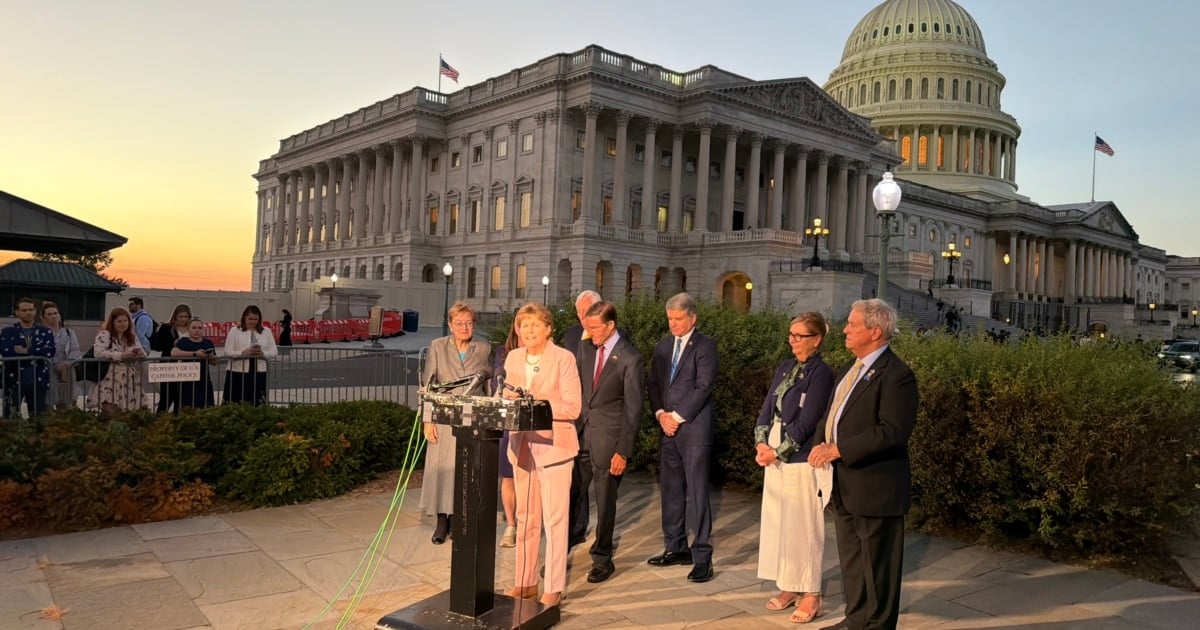
β’ House Speaker Mike Johnson and Senate Majority Leader John Thune unveiled a plan to fully fund the Department of Homeland Security, resolving a 48-day partial government shutdown.
β’ The agreement bypasses prior splits between GOP leaders, aiming to restore pay for affected federal workers.
β’ Trump endorsed the measure, signaling he will sign a related executive order soon.
β’ Congress reauthorized the Dr. Lorna Breen Health Care Provider Protection Act, extending mental health support programs for healthcare professionals through September 2030.
β’ Named after emergency physician Dr. Lorna Breen, who died by suicide during the COVID-19 pandemic, the law addresses burnout among nurses and others.
β’ The legislation continues federal initiatives to improve workplace conditions and reduce mental health challenges in healthcare.
β’ President Trump is pressing Congress to cut short its two-week recess and return to fund the Department of Homeland Security, now over 40 days into the longest partial government shutdown in U.S. history.
β’ White House press secretary Karoline Leavitt stated Trump offered to host a big Easter dinner if lawmakers return to fight Democrats on the issue.
β’ The House passed a bill to fund DHS through May 22, but top Democrats called it 'dead on arrival' in the Senate; Senate partially funded DHS except ICE and border protection last Friday.
β’ House Speaker Mike Johnson rejected a Senate-negotiated Department of Homeland Security funding deal early Friday, dramatically denouncing the agreement reached after weeks of effort by Senate Majority Leader John Thune.
β’ The collapse leaves DHS in a partial shutdown since mid-February with Congress now on a two-week spring break, creating an impasse with no clear path to resolution.
β’ The rupture between the two top Republican leaders exposes rare discord as they work to advance President Trump's priorities before November elections.
β’ President Trump called on a gridlocked Congress to establish a unified national AI regulatory framework to prevent a patchwork of state laws on March 28, 2026.
β’ States have enacted dozens of AI laws covering child safety, transparency requirements, and whistleblower protections due to federal inaction.
β’ The White House framework emphasizes protecting children from AI harms and consumers from data center cost increases, prompting mixed reactions from lawmakers.
β’ Reps. Nikki Budzinski (D-Ill.) and Adrian Smith (R-Neb.) introduced the Preventing Real-time Exploitation and Deceptive Insider Congressional Trading Act on March 25, 2026, prohibiting members of Congress, the president, vice president, spouses, dependents, and senior executive branch employees from trading in prediction markets on political events or policy decisions.
β’ The bill imposes civil penalties of 10% of the violating transaction's value plus full disgorgement of profits to the U.S. Treasury, amid rising bipartisan concerns over platforms like Polymarket and Kalshi.
β’ 'The American people are tired of politicians using their influence for personal gain, and the rise of prediction markets has made those concerns even more relevant,' Budzinski stated.
β’ On March 20, 2026, the White House issued the National Policy Framework for AI, urging Congress to preempt state laws and promote innovation.
β’ Framework emphasizes five principles: child safety, communities, creators, censorship prevention, and U.S. competitiveness, building on December 2025 executive order.
β’ Recommendations include protections against AI scams, workforce training via land-grant institutions, and free speech safeguards for AI outputs.
β’ Republicans in Congress are escalating investigations into multiple aspects of the Trump administration, including communications between the administration and private companies, financial contributions to Trump's White House ballroom, and settlement funds for the Trump Presidential Library.
β’ Congressional Republicans are scrutinizing federal contracts awarded to companies with ties to the administration, potentially improper use of government information by the Department of Government Efficiency (DOGE), and business investments related to Trump family interests in defense, drone, crypto, real estate, and media industries.
β’ Investigations are also focusing on presidential pardons, with Democrats seeking transcribed interviews of individuals pardoned by Trump and related parties where allegations exist of donations or inappropriate influence linked to the pardons.
β’ House Republicans announced an investigation into rampant hospice fraud in Southern California, alleging tens of millions in taxpayer funds lost to improper payments.
β’ The House Oversight Committee sent a letter to Governor Gavin Newsom requesting documents on state oversight of federally funded hospice programs.
β’ Fraud involves companies receiving payments for ineligible patients, prompting calls for stronger controls amid ongoing healthcare waste concerns.
Airline CEOs have urged Congress to restore funding to the TSA as lengthy security lines plague US airportsSign up for the Breaking News US email to get newsletter alerts in your inboxDelta Air Lines is partly suspending its speciality service desk for members of Congress until funding for the Transportation Security Administration (TSA) is restored, the airline confirmed on Tuesday, as security lines stretch for hours at airports across the country due to the Department of Homeland Security (DHS) shutdown.The service desk is used to help members of Congress book flights at special government rates, secure airport escorts and make last-minute changes to flights. Continue reading...