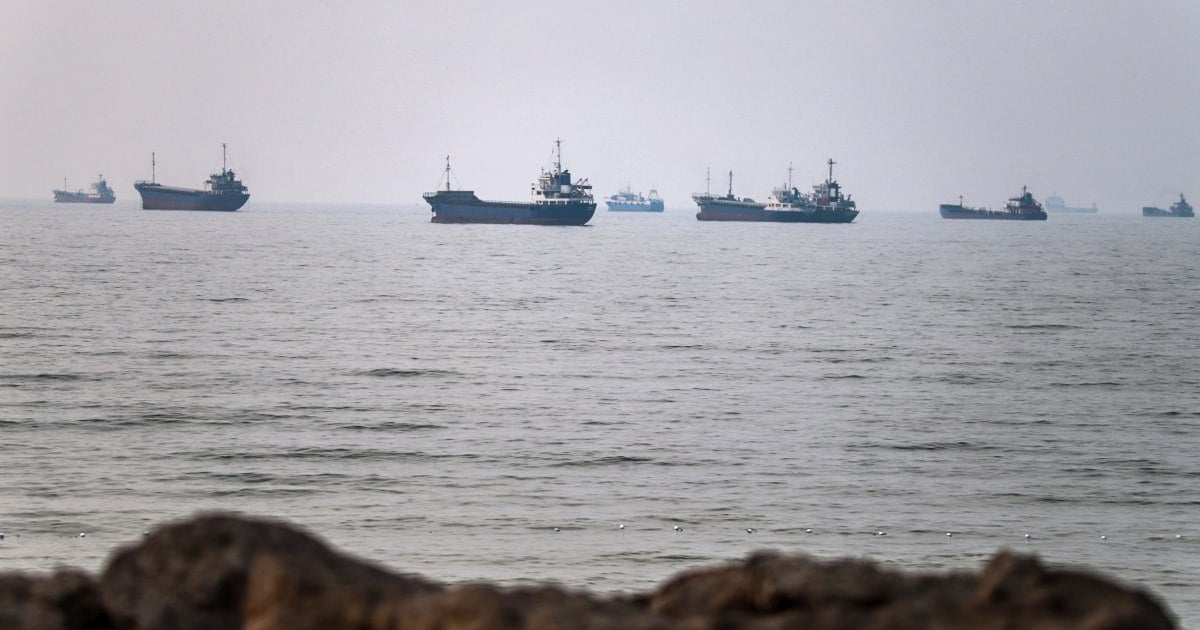
US Navy to impose blockade today in bid to choke off flow of Iranian oil Explainer: strait of Hormuz blockadeBusiness live – latest updatesOil prices have jumped back above $100 a barrel after weekend talks between the US and Iran ended without an agreement and Donald Trump imposed a blockade of the strait of Hormuz.The US president announced the blockade on Sunday, targeting Iranian vessels and ships that have paid a toll to Iran for passage through the strait, in an attempt to choke off the flow of Iranian oil. Continue reading...
• Russian President Vladimir Putin offered to mediate between the United States and Iran following the collapse of 21-hour nuclear negotiations, according to the Kremlin.
• The Russian mediation offer comes as the Trump administration pursues an increasingly confrontational stance, including announcing a Strait of Hormuz blockade.
• Putin's intervention signals Russia's desire to position itself as a diplomatic player in Middle Eastern affairs and potentially exploit U.S.-Iran tensions.
• President Trump announced on April 12 that the U.S. Navy would begin a blockade of the Strait of Hormuz and intercept any vessel that has paid tolls to Iran to transit the strait safely, following the failure of 21-hour nuclear negotiations.
• Vice President JD Vance confirmed in Islamabad that no agreement was reached, with Iran's refusal to abandon its nuclear program cited as the primary sticking point.
• Iran's state-affiliated Fars news agency reported the country has no plan for a next round of negotiations, marking a significant escalation in the U.S.-Iran conflict.
• Vice President JD Vance announced at a press conference in Pakistan on April 12 that 21 hours of negotiations with Iran have concluded without reaching an agreement, with the primary sticking point being Iran's refusal to abandon its nuclear program.
• Vance characterized the lack of progress as "bad news for Iran," while Iran's state-affiliated Fars news agency reported that Tehran has "no plan for a next round of negotiations" according to sources close to the negotiating team.
• The failed talks carry significant implications for Middle East stability and global security, with experts examining how the diplomatic breakdown affects ongoing regional conflicts and US-Iran relations.
Iran warns move would breach ceasefire as US president also repeats threats to strike critical infrastructureDonald Trump has said the US will begin blockading the strait of Hormuz in an attempt to take control of the strategic waterway from Iran in the aftermath of failed peace negotiations between the countries in Pakistan.The US president also threatened to bomb Iran’s water treatment facilities as well as its power plants and bridges, repeating an earlier threat, if Tehran did not agree to abandon its nuclear weapons programme – the key sticking point between the two sides. Continue reading...
Two sides tested one another’s resolve but timeframe meant it was probably unrealistic to expect deal Middle East crisis – live updatesIt was if the two delegations in the Iran-US peace talks in Islamabad hoped that the sheer number of negotiators flown into Pakistan could overcome the handicap of having only a finite number of hours in which to settle a 20-year dispute over Iran’s nuclear ambitions, now overlaid by complex new issues such as future control of the strait of Hormuz and US compensation for its attack on Iran.Iran sent two planeloads of negotiators, including many members of the Islamic Revolutionary Guard Corps (IRGC) present to ensure that no gains made in the field were relinquished at the diplomatic table. Diplomats fanned out across political, legal, security, economic and military files. One Iranian-drafted technical explanation on nuclear facility safety ran to more than 100 pages. Continue reading...
Oil prices and borrowing costs are expected to rise this week as tankers remain stranded in Persian gulfMiddle East crisis live – latest updatesThe failure of the US and Iran to reach a peace deal after marathon negotiations has put markets on alert for further oil and gas price rises.With large numbers of oil tankers remaining stuck in the Persian gulf, the US vice-president, JD Vance blamed the collapse of the talks on Tehran’s refusal to abandon its nuclear weapons programme, while Iranian sources hit back at “excessive” demands from Washington. Continue reading...
President has long been a fan of mixed martial artsIvanka and Donald Trump Jr also at eventDonald Trump and US secretary of state Marco Rubio attended a UFC event in Miami night on Saturday as peace talks with Iran failed on the other side of the world.Trump entered the Kaseya Center shortly after 9pm alongside several members of his family and UFC chief Dana White, who has been a supporter of the president since his first term. Seated nearby was Rubio as well as US ambassador to India Sergio Gor, the rapper Vanilla Ice and former FBI deputy director Dan Bongino. Continue reading...
Iranian sources, however, blame ‘excessive’ demands from Washington for breakdown of talks in Islamabad to resolve US-Iran conflictMiddle East crisis – liveThe US vice-president, JD Vance, has blamed the failure of marathon negotiations with Iran on the country’s refusal to abandon its nuclear weapons programme, while Iranian sources have hit back at “excessive” demands from Washington.Vance, who left Islamabad on Sunday morning after 21 hours of talks with Iranian officials in the Pakistani capital, said his team had been very clear on its red lines, as hopes faded of a quick end to the conflict that began on 28 February. Continue reading...
Australia’s foreign affairs minister says priority ‘must be to continue the ceasefire and return to negotiations’Get our breaking news email, free app or daily news podcastAustralia’s foreign affairs minister, Penny Wong, has urged the US and Iran to continue the ceasefire and return to negotiations quickly, after peace talks failed to secure a deal or the re-opening of the strait of Hormuz.Historic face-to-face meetings in Pakistan – marking the highest-level of direct engagement between Washington and Tehran in decades – seemingly broke down after a marathon 21-hour first day of talks. Continue reading...
US and Iranian media report peace talks have begun in Islamabad, while Netanyahu says Israel remains committed to fighting IranUS and Iran hold talks in Islamabad as Pakistan seeks to broker peace dealUS officials claim Iran unable to find mines it laid in strait of HormuzThe UK will host a strait of Hormuz meeting next week, bringing together multiple countries aiming to restore free movement of ships through the strait, which has been blockaded by Iran since the beginning of the war and inflicted heavy damage on the global economy.A British official told AP that the meeting will oppose the idea of tolls being charged for passage through the waterway, as proposed by Iran as part of ceasefire negotiations. Continue reading...
JD Vance leads American delegation while Iran’s negotiators headed up by Iran’s parliamentary speakerPeace talks between Iran and the US began in Islamabad this afternoon, with senior negotiators from both countries meeting face to face at the highest level for the first time since 1979, in the presence of mediators from Pakistan.Pakistani state TV said US and Iranian officials were “sitting directly at the same table” – which was later confirmed by the White House – and discussions were beginning in a positive atmosphere, despite fighting ongoing in Lebanon. Continue reading...
• President Donald Trump has intensified pressure on Iran as negotiations approach, signaling a harder stance in diplomatic discussions.
• The administration's strategy reflects Trump's approach to foreign policy negotiations, combining public pressure with diplomatic engagement.
• Analysts view the timing and rhetoric as a negotiating tactic designed to strengthen the U.S. position before formal talks commence.
• Iran has laid out preconditions for ceasefire negotiations with the United States, including a truce in Lebanon and the release of frozen Iranian assets before substantive talks can proceed.
• The Iranian position reflects the broader regional conflict dynamics, with fighting extending beyond US-Iran direct confrontation to proxy conflicts in Lebanon and other Middle Eastern locations.
• These conditions complicate already delicate negotiations in Pakistan, as the US and its allies assess whether such demands can be accommodated within broader regional security frameworks.
• Israeli Prime Minister Benjamin Netanyahu has authorized direct negotiations with Lebanese representatives, marking a potential diplomatic breakthrough in the broader Middle Eastern conflict landscape alongside US-Iran ceasefire talks.
• The parallel diplomatic tracks suggest efforts to compartmentalize various conflicts within the region and create opportunities for broader de-escalation beyond direct US-Iran confrontation.
• These negotiations involve coordination with US authorities, reflecting Washington's strategic interest in achieving regional stability across multiple conflict zones simultaneously.
• Fresh tensions have surfaced just as formal ceasefire negotiations between US and Iranian representatives commence in Pakistan, threatening to derail diplomatic efforts.
• The timing of new military incidents and heightened rhetoric suggests both sides remain committed to military posturing even as they engage in peace talks, a pattern common in complex regional conflicts.
• Diplomatic observers note that success will require both delegations to compartmentalize military operations from negotiation processes, a significant challenge given recent escalations including the downing of a US fighter jet.
• Wall Street stocks closed mixed on Friday, April 10, 2026, with S&P 500 down 0.1% at 6,816.89, Dow dropping 0.6% to 47,916.47, and Nasdaq up 0.4% to 22,902.90 amid anticipation of U.S.-Iran talks post-ceasefire.
• Healthcare stocks led declines with Eli Lilly falling 1.8% and Johnson & Johnson down 1.3%, offset by tech gains including Nvidia up 3% and Broadcom rising 5.3%.
• Oil prices slipped while major indexes recovered most March losses from Iran conflict, now just 2.3% below S&P 500's January all-time high, though volatility persists on war news.
• Pakistan has positioned itself as a primary mediator between the United States and Iran following the recent Middle East war, leading efforts to end hostilities after Trump's threats prompted a White House reversal.
• Peace talks are set to begin in Pakistan on April 10, welcomed by India, as the two-week ceasefire takes hold amid reshaping West Asian strategic landscape.
• China supports Pakistan's role, having jointly submitted a five-point truce plan with Islamabad to reopen the Strait of Hormuz before escalation.
US is in weaker position than before war as Tehran has shown capacity to inflict pain on Trump administrationMiddle East crisis – live updatesThe announcement of a two-week ceasefire has allowed Donald Trump to hail the reopening of the Hormuz strait as a victorious dawn of a new golden age, but it is Iran that now enters peace talks with the stronger hand.The Tehran regime goes to the negotiations planned for Friday in Pakistan bloodied but still intact. It still holds a stockpile of highly enriched uranium (the original crux of the conflict with the US, Israel and allies), and it now claims at least part-control of the strait, having demonstrated its power to close the narrow waterway and hold the world to ransom. Continue reading...
• U.S. stock futures surged with S&P 500 Index futures climbing 25 points to $6,600 after President Donald Trump announced a two-week suspension of Iran attacks pending agreements.
• Oil prices fell sharply in response to the de-escalation news, easing supply disruption fears and boosting market sentiment on Monday morning.
• The rally reflects investor optimism over potential US-Iran talks and a 50-day ceasefire, reducing geopolitical risks impacting energy and equities.
Members reportedly agree rise of 206,000 barrels a day in May but move symbolic with strait of Hormuz effectively closedMiddle East crisis – live updatesIranian drones struck Kuwait’s oil infrastructure on Sunday, causing “severe material damage” that threatened to further disrupt oil supplies already hit by the US and Israel’s war with Tehran.It came hours before members of the Opec+ group that represents major global oil suppliers gathered to discuss how to bolster output despite Iran’s effective closure of the crucial strait of Hormuz shipping route. Continue reading...
• US stock markets opened higher on March 30, 2026, with the S&P 500 up 0.33% or 21 points, Dow up 0.46% or 209 points, and Nasdaq up 0.2% or 41 points amid optimism over Trump-Iran negotiations.
• President Trump stated Washington is in serious discussions with a more reasonable regime to end the war, warning Iran to reopen the Strait of Hormuz or face strikes on its oil infrastructure, boosting sentiment.
• Energy stocks led gains with S&P 500 Energy Index up 1.5%, Exxon Mobil climbing 3%, and Chevron adding 1.5%, while oil rose $2.44 to $102.10.
Tehran says it will confront any land attack, as Trump says regime’s export hub on Kharg Island could be taken ‘very easily’. Plus, how Americans can rebuild its once robust peace movementGood morning.Iran has warned the US that it is prepared to confront any ground assault, accusing Washington of secretly planning a land attack while publicly seeking talks, as the war that has killed thousands of people and caused the biggest ever disruption to global energy supplies entered its second month.What has Donald Trump said? In an interview published last night, the US president did little to assuage those concerns, telling the Financial Times that his “preference would be to take the oil” in Iran, and saying of Iran’s crucial export hub on Kharg Island: “We could take it very easily.”This is a developing story. Follow the liveblog here.Why is this important to Cuba? The thousands of barrels of crude would provide significant relief to Cuba, which, according to the president, Miguel Díaz-Canel, has not received any oil imports for three months, leading to strict rationing of gasoline and exacerbating an energy crisis that has resulted in multiple power outages across the country. Continue reading...
• Regional diplomats from Saudi Arabia, Turkey, and Egypt met in Pakistan on Sunday to establish a framework for direct US-Iran negotiations, with foreign ministers expected to reconvene Monday to discuss peace terms.
• Iran's parliament speaker Mohammed Bagher Qalibaf warned that Iranian forces are "waiting for the arrival of American troops on the ground to set them on fire," while dismissing the US 15-point action list as negotiating under pressure.
• The US has deployed thousands of troops to the Middle East including 2,500 Marines aboard USS Tripoli and elements of the 82nd Airborne Division, signaling preparations for potential ground operations despite diplomatic efforts.
Tehran says it will confront any land attack, as Houthi missiles fired at Israel signal further escalation in regionMiddle East crisis – live updatesIran has warned the US that it is prepared to confront any ground assault, accusing Washington of secretly planning a land attack while publicly seeking talks, as the war that has killed thousands of people and caused the biggest-ever disruption to global energy supplies entered its second month.As efforts to find a negotiated conclusion to hostilities inched forward with a meeting of regional powers in Pakistan, there were signs of further escalation over the weekend as Yemen’s Iran-backed Houthis entered the conflict for the first time, and the Israeli prime minister, Benjamin Netanyahu, said his country was widening its invasion of southern Lebanon. Continue reading...
Reluctance to cheerlead alleged US ceasefire efforts reflects suspicion talk of peace could be another foil for escalationMiddle East crisis – live updatesNot long after Donald Trump said the US was engaged in “strong talks” to bring the war with Iran to an end this week, Qatar took the unusual step of distancing itself from the alleged diplomatic negotiations.Qatar was not involved in any mediation efforts, said Majed al-Ansari at a briefing on Tuesday night, before adding as a telling aside: “If they exist.” Continue reading...
Pakistani intermediaries deliver 15-point plan but some proposals proved intractable in previous negotiationsIranian officials expressed initial disapproval of a US ceasefire plan on Wednesday, even as intermediaries suggested direct talks between the two could start as early as this weekend.Representatives from Pakistan who reportedly delivered the US plan to Iran told the Associated Press that it was a 15-point proposal that would include sanctions relief for Iran, dismantling Iran’s nuclear programme, restricting its use of missiles and reopening the strait of Hormuz, a chokepoint for about 20% of the world’s oil. Continue reading...
• President Donald Trump stated the US is negotiating with Iran to end the three-week-old war, citing two days of 'very good and productive conversations' after Iran reportedly reached out, with talks set to continue this week.
• Trump refused to name the 'top' Iranian official involved, only saying it was not new Supreme Leader Mojtaba Khamenei, and claimed he would 'jointly control' the Strait of Hormuz with 'whoever the next Ayatollah is'.
• US and Israeli airstrikes continued across Iran, targeting Tehran, Tabriz, Isfahan, Karaj, gas facilities, and a pipeline, with Iran reporting over 1,500 civilian deaths since February 28.
Israel and Gulf states targeted and Iran hit by airstrikes as Tehran denies negotiations are taking place to end warMiddle East crisis – live updatesViolence has continued across much of the Middle East, a day after Donald Trump said the US was in “very good” talks with Iran to end the war in the region soon.Iranian barrages targeted Israel, Gulf Arab states and northern Iraq on Tuesday, while Israeli and US warplanes continued to carry out strikes across Tehran and on other targets in the Islamic Republic. Continue reading...
Iran has dismissed the US president’s claim of talks, saying there had been none since Washington began bombing the country. Plus, how sleeping 11 minutes more can cut your risk of heart attackGood morning.Donald Trump said there have been talks between the US and Iran over the past day in which the two sides had “major points of agreement” – but Tehran denied the claim, saying there had been no talks since the US began bombing Iran 24 days ago. Continue reading...