technology·Par NewzBits Editorial·7 min de lecture·
Claude Fable 5.1 is not your new default
Anthropic's top generally available model still costs twice Opus 5. Cache reads dropped 75%, so long agent runs can undercut Fable 5. Start with Opus.
Par NewzBits Editorial
Anthropic shipped Claude Fable 5.1 on 1 September 2026. The useful sentence is not in the launch post. It is in the model docs: for most workloads, start with Claude Opus 5. Use Fable 5.1 when Opus still fails your evals at high effort, or when the job is long-horizon agent work that actually needs the extra reasoning.
That is the buying guide. The rest of this piece is the receipts.
Fable 5.1 is the generally available twin of Claude Mythos 5.1. Same underlying model, different safeguards. Mythos is invitation-only, through Project Glasswing and related trusted-access programs. Fable is the one you can actually call.
The API id is claude-fable-5-1. On Amazon Bedrock it is anthropic.claude-fable-5-1. Google Cloud, Microsoft Foundry, and Claude Platform on AWS use claude-fable-5-1. Pro, Max, Team, and Enterprise seats get it in the Claude apps. Context is 1 million tokens, billed at the standard rate across the whole window. Max output is 128k tokens. Thinking is adaptive and always on. Default effort on the API is high. Knowledge cutoff is June 2026. Input is text and images; output is text. Anthropic rates it slower than Opus 5.
The sticker price did not drop. The cache price did.
Input is still $10 per million tokens. Output is still $50. Opus 5 is $5 and $25. Sonnet 5 is $2 and $10. You are not getting a cheaper flagship. You are getting a cheaper reread.
Cache reads on Fable 5.1 (and Mythos 5.1) are $0.25 per million tokens. That is a quarter of Fable 5, and 2.5% of the input price. Other Claude models still charge 10% for a cache hit. Anthropic’s announcement puts typical token-billed work at about 25% less than Fable 5, and heavy agent work at up to about 45% less. Those figures come from four weeks of August 2026 usage at default effort, not from a synthetic microbenchmark.
Cache writes did not move: $12.50 per million for a five-minute write, $20 for a one-hour write. Batch is half off ($5 input, $25 output). US-only inference is 1.1× on input and output.
So the math splits. Short prompts with little cache: Fable 5.1 costs about twice Opus 5 and runs slower. Long agent loops that keep rereading a large prefix: 5.1 can undercut Fable 5 while scoring higher. If you are about to point every session at Fable 5.1 because it topped a chart, that first case is the one you will actually live in.
Claude Code defaults to high effort. Claude Cowork and claude.ai default to medium. Anthropic says low and medium on 5.1 land in the same quality band as Fable 5, cheaper. Effort also goes to xhigh and max.
The charts, with the caveats still attached
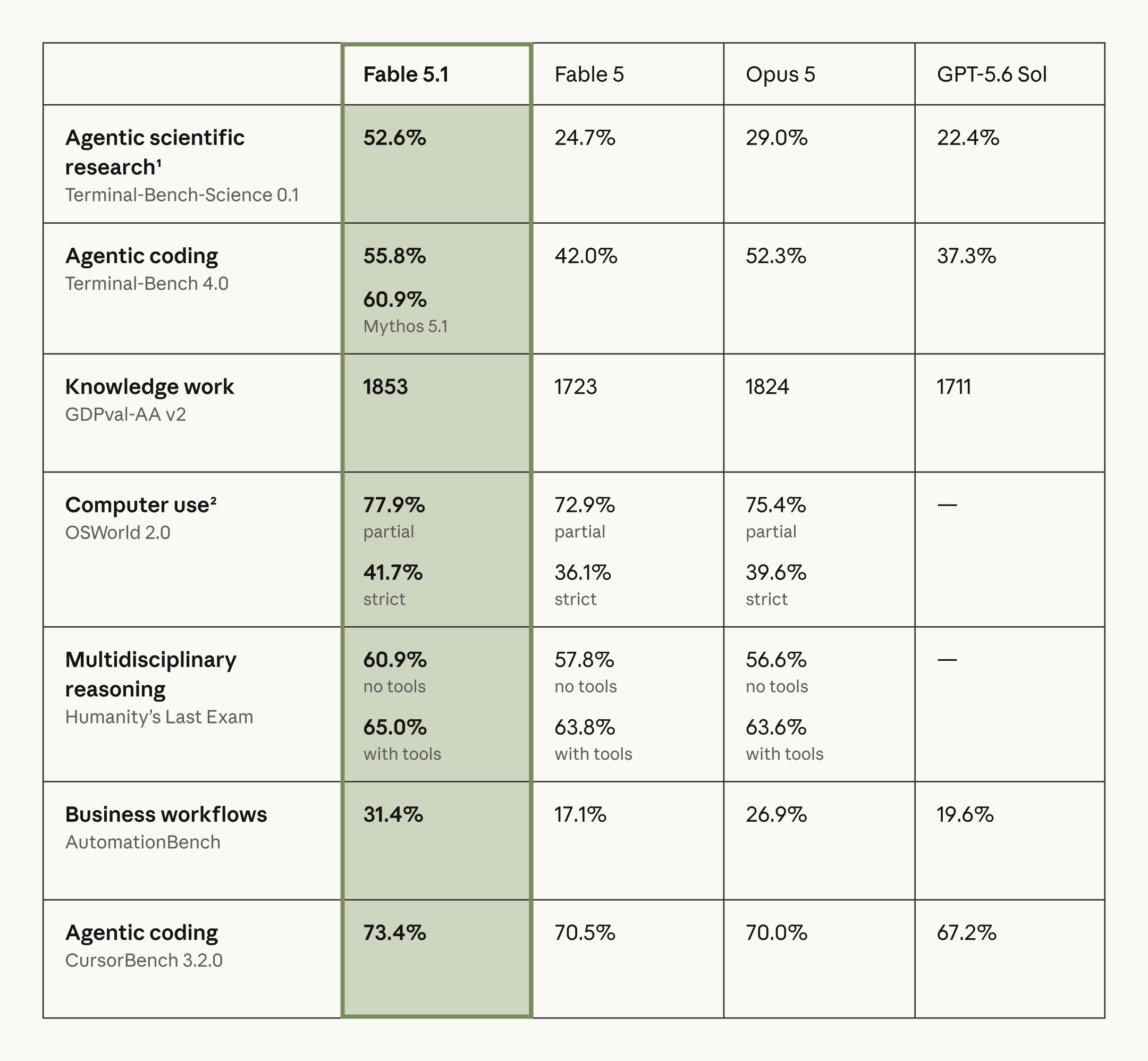
Anthropic published scores with production safeguards on.
Anthropic’s scores with production safeguards on. Source: Introducing Claude Fable 5.1.
That matters, because interrupted tasks scored zero on OSWorld 2.0, and leftover cyber work was handed to Opus 4.8, leftover biology to Opus 5. A green eval in your harness does not prove Fable answered every prompt. Reroutes are not billed at Fable prices.
On Terminal-Bench 4.0, Fable 5.1 is at 55.8%. Opus 5 is at 52.3%. Fable 5 is at 42.0%. GPT-5.6 Sol is at 37.3%. Mythos 5.1, same model, fewer cyber interruptions, is at 60.9%.
The widest gap is agentic science. Terminal-Bench-Science 0.1: 52.6% for Fable 5.1, 29.0% for Opus 5, 24.7% for Fable 5, 22.4% for Sol. Standard error is ±3.5–4.5 points. The public leaderboard (Claude Code harness, three trials per task) has Opus 5 at 30.0% and Fable 5 at 21.4%; Anthropic’s setup reproduces 29.0% and 24.7%, which it calls within noise.
CursorBench 3.2.0 is tighter: 73.4% versus 70.0% for Opus 5 and 70.5% for Fable 5. Humanity’s Last Exam without tools is 60.9% versus 56.6% Opus and 57.8% Fable 5; with tools, 65.0% versus 63.6% and 63.8%. AutomationBench moves more: 31.4% versus 26.9% Opus and 17.1% Fable 5. GDPval-AA v2 is 1853 versus 1824 Opus. OSWorld 2.0 uses the authors’ August 2026 task release, so Anthropic does not print a competitor score.
The what’s-new notes match the charts more than the slogans: long unattended coding, documents and spreadsheets and slides from a blank page, multistep research, dense PDFs, the full million-token window, computer use. Multilingual is even with Fable 5. Parallel tool calls are less consistent than on Fable 5. It talks less between tools. At low effort it answers from memory more often. Prose can get denser. It likes rewriting a whole file for a small edit.
If you already send claude-fable-5
Three things break. They are not warnings. They are 400s and dropped thinking blocks.
Forced tool use is gone. tool_choice of type “any” or “tool” returns 400. Auto and none still work. Thinking is always on; a forced tool would skip it, and the model would dump its working-out into the arguments.
Thinking blocks only travel forward. Fable 5.1 can read older Claude thinking. Older models cannot read its blocks. Fall back to Opus 5 mid-conversation and those blocks disappear. Dropped blocks are not billed.
Editing earlier turns invalidates thinking. Change the system prompt, the tool list, or an old message, and the next request errors, or drops the block if you opt in. Accounts created on or after 31 August 2026 get the check. Older accounts only if you set prefix_mismatch_behavior. Mythos 5.1 skips it. Keep the transcript append-only. Per-turn reminders belong in turn-scoped system messages, not in text you inject and delete.
On privacy, Anthropic’s own pages do not say one thing. The Fable product page says 30-day retention for safety monitoring by default. The API docs call Fable 5.1 a Covered Model and say zero data retention is off unless Anthropic authorizes it. The announcement is the bridge: Enterprise Frontier Safeguards store data on the customer’s cloud, with customer-side review, rolling out in phases later this fall. Eligible customers can run Fable 5.1 with zero retention until EFS is ready. Keep both sentences. Do not flatten them into “it’s ZDR now.”
Cyber safeguards now allow vulnerability discovery, not exploit writing. Anthropic claims about 60% fewer false positives than before, and about 60% fewer Claude Code interruptions per session than the old Fable 5 rules. Pentests, exploit generation, and binary-based vuln scanning still bounce to Opus. Life-sciences R&D still bounces to Opus. Elementary medical questions fire 85% less often than at Fable 5 launch.
Retirement is not before 1 September 2027.
If Opus 5 already clears the work, stay there. If you are on Fable 5 for long agent loops, 5.1 is the same list price and a cheaper cache, with three client changes you should fix before you flip the id. If you were going to make Fable 5.1 the default because it is “the most capable generally available model,” that is Anthropic’s phrase. Their docs still tell you to start with Opus.