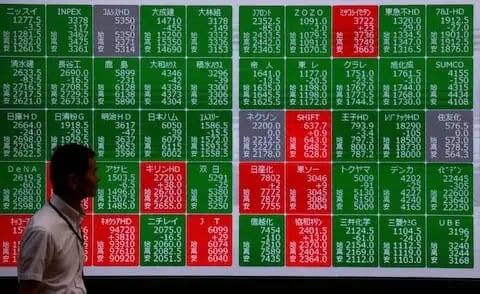
• Equity benchmarks Sensex and Nifty closed lower after intraday swings, pressured by spiking crude oil prices above $90/barrel.
• Foreign investor outflows accelerated to ₹15,000 crore in April, exacerbating downside in banking and energy sectors.
• Auto and FMCG stocks like Maruti Suzuki and ITC provided limited support amid broader risk aversion.
• Twenty companies featured in Indianapolis Business Journal's 2025 Innovation Issue have all remained operational and demonstrated growth through new product launches, funding rounds, or strategic partnerships.
• The continued viability of the cohort signals resilience in the regional tech ecosystem despite broader market headwinds and shifting investor priorities toward profitability and sustainability.
• Sustained momentum among IBJ's tracked startups reflects emerging strength in Midwest technology innovation and the region's capacity to nurture scalable ventures.
• Market experts identify fundamentally strong value stocks as attractive investment opportunities following recent market corrections driven by geopolitical tensions and crude oil price volatility.
• Analysts recommend disciplined investors focus on quality companies trading at depressed valuations rather than panic-driven selling, viewing current market weakness as potential entry points for long-term wealth creation.
• Selective turnaround stocks and NBFC sector opportunities are highlighted as potential beneficiaries of market recovery, with emphasis on portfolio construction based on fundamental strength rather than technical indicators.
• India's Goods and Services Tax (GST) collections increased 8.7% to ₹2.42 lakh crore, demonstrating continued economic strength despite recent market corrections and global uncertainties.
• The strong GST collection figures reflect robust consumer spending and improved tax compliance across India's formal economy, providing crucial revenue for government budgets.
• This economic indicator comes amid broader market volatility, with Wall Street posting its best month since 2020, suggesting potential stabilization in global financial conditions affecting Indian markets.
• Asia-Pacific's cross-border payments market, valued at $13.5 trillion in 2025, is forecast to surge to $24 trillion by 2033, fueled by QR payments and digital adoption.• Thailand ranks second in regional economic optimism, supporting robust growth in transaction volumes across Southeast Asia.• Expansion driven by e-commerce boom and fintech innovations enhances trade efficiency in Singapore, Malaysia, Indonesia, and Vietnam.• Regulators eye next steps in harmonizing standards to sustain projected CAGR amid rising geopolitical tensions.
• Startup TextWeave secured $10 million in seed funding last month to leverage LLMs for generating marketing copy for small shops.
• The platform addresses niche needs in content creation, demonstrating how specialized AI fixes fuel startup growth.
• This funding aligns with enterprise adoption trends, where generative AI tops technology startup news for tasks like automated writing.
• A federal appeals court has overturned a lower‑court injunction that had ordered the Trump administration to restore the flow of federal grants to several local governments, reopening billions of dollars in funding that had been withheld.
• The decision follows a dispute over how the administration interprets the conditions attached to federal grants, with cities arguing that the withholding amounted to political retaliation.
• The ruling could influence how future administrations may or may not condition aid on policy compliance, and it has implications for federalism and local autonomy.
• Insurance giant Cigna announced it will exit the Affordable Care Act individual market in 2027, impacting 369,000 members amid reports of millions dropping Obamacare coverage due to higher long-term costs.
• State officials and industry analysts note surging premiums are driving enrollment declines, exacerbating access issues for remaining policyholders.
• Cigna reported a $1.65 billion profit while making the exit, highlighting tensions between profitability and marketplace sustainability.
Colombia hosted nearly 60 countries at pivotal time on world stage for fight to transition to a clean energy futureLooking out to sea from the grey sandy beaches of Santa Marta, on Colombia’s Caribbean coast, it is never hard to spot evidence of the country’s thriving fossil fuel export trade. Oil tankers ride at anchor on the horizon, and sometimes, locals say, lumps of coal wash up on the shore, blown off the collier ships that carry cargos from the nearby mines.It was here, on Wednesday evening, that the Colombian government took a bold step to shift its economy – and that of the rest of the world – away from dependence on coal, gas and oil and into a new era of clean energy. With the first ever conference on “transitioning away from fossil fuels”, the host joined nearly 60 countries determined to loosen of the grip of petrostates on the world’s future. Continue reading...